A break-in can change the way you look at your home.
A window that was simply opened for ventilation can suddenly look like a vulnerable entry point. A door that had always seemed secure may be viewed very differently once someone has tried to force it.
For some homeowners, the immediate response is to secure almost every accessible door and window. Others concentrate on the point where entry was gained. Increasingly, people are also reviewing their home security before anything happens at all — after hearing about an incident nearby, moving into a new home or simply wanting to feel comfortable leaving windows open at night.
There is no single response that is right for every home.
However, research into repeat and near-repeat burglary shows there are good reasons to review security following a break-in or nearby incident. Having experienced a break-in does not mean it will happen again, but research shows there can be a period of increased risk and vulnerabilities may have been exposed that are worth addressing.
The important thing is to respond with facts and a plan rather than fear.
In This Guide
- Why Can a Home Be More Vulnerable After a Break-In?
- What Is Near-Repeat Burglary — and Why Do Nearby Homes Matter?
- Why Police and Researchers Take Repeat Burglary Seriously
- What Break-Ins Actually Look Like in My Experience
- Remove the Easy Opportunity
- How Much of the Home Should You Secure?
- Acting Quickly Without Acting Hastily
- Prioritise Vulnerable Openings — Especially Those You Want to Leave Open
- Why Home Security Works Best in Layers
- Looking Secure and Being Secure Are Not the Same Thing
- What Happens When a Proper Security Door Is Actually Attacked?
- Why Installation Matters as Much as the Product
- What Does SL200 Tell a Homeowner?
- Repair, Upgrade or Replace?
- More Homeowners Are Trying to Get Ahead of the Problem
- What Does a Good Security Solution Actually Look Like?
- Security Is Also About Being Comfortable in Your Home
- What Should You Do After a Break-In or Nearby Incident?
- A Sensible Response, Not a Fearful One
- Frequently Asked Questions About Home Security After a Break-In
- Sources & Further Reading
Why Can a Home Be More Vulnerable After a Break-In?
Repeat victimisation has been studied by criminologists for decades.
The Australian Institute of Criminology has reported that when repeat offences occur, they often happen relatively quickly. This is one reason crime-prevention measures can be particularly valuable when introduced soon after an incident.
Researchers generally discuss two possible reasons for repeat burglary.
The first is that some properties have characteristics that already make them more vulnerable. The location, access, layout, routines of the occupants or level of security may make one home easier to enter than another.
The second is that something may change after the first burglary. Knowledge can be gained about the property, its layout or its security weaknesses.
For a homeowner, the important point is much simpler.
If a weakness has already allowed someone to gain entry, it makes sense to identify that weakness and ask whether the same problem exists elsewhere around the home.
What Is Near-Repeat Burglary — and Why Do Nearby Homes Matter?
The research becomes even more interesting when neighbouring homes are considered.
Burglary does not always occur as a collection of completely unrelated incidents. Researchers have found patterns where the risk of another burglary can temporarily increase around the location of a recent offence.
Research summarised by the College of Policing has found elevated near-repeat burglary risk around recently burgled homes, with the effect generally strongest closer to the original incident and in the weeks following it.
These findings should not be treated as a prediction that a neighbour will be burgled.
They tell us something more useful: a nearby burglary can be a reasonable prompt to review your own security rather than simply dismissing the incident as having nothing to do with your property.
I have seen this throughout my working life, particularly in retirement villages, residential complexes and local neighbourhoods.
What the research tells us
- Homes that have already experienced burglary can face a higher short-term risk of repeat burglary.
- Queensland research has found previously burgled homes were more likely to be burgled again.
- Near-repeat research also identifies a temporary increase in risk around nearby properties.
- Increased risk does not mean another burglary is inevitable.
Sources: Australian Institute of Criminology; College of Policing; Queensland burglary research.
When one resident experiences a break-in, other residents often begin looking more closely at their own doors and windows. Sometimes they tell me about the incident when they first request a quote. Other times I do not find out until I am installing the job and the customer mentions that a neighbour was recently broken into.
For many years I assumed much of this was simply because an incident had brought home security to the front of people’s minds.
That is undoubtedly part of it.
But research into near-repeat burglary suggests there can also be a practical reason for nearby residents to take the opportunity to look at their own homes — particularly where properties share similar layouts, doors, windows or security arrangements.
Why Police and Researchers Take Repeat Burglary Seriously
Repeat and near-repeat burglary have been studied closely enough to influence practical crime-prevention strategies.
Police approaches have included targeting recently burgled properties and nearby homes with security advice and prevention measures. This is sometimes known as cocooning — focusing attention not only on the original victim but also on surrounding properties.
Researchers have also used mathematical and statistical models to study how burglary risk changes across time and distance following an incident.
Homeowners do not need to understand the mathematics.
What matters is that repeat and near-repeat burglary are established enough concepts to influence real crime-prevention strategies.
You do not need to assume another burglary is going to happen.
You can simply use the incident as new information about where vulnerabilities may exist.
What Break-Ins Actually Look Like in My Experience
One thing I have noticed over many years in the security industry is that people often imagine break-ins being much more sophisticated than they really are.
Customers sometimes picture someone cutting glass as they might see in a movie, or smashing large windows to gain entry.
That is rarely what I personally encounter.
In my experience, many break-ins involve a much simpler route into the home.
I have seen ordinary flyscreens cut or removed so someone can enter through an open window. I have seen screwdrivers used behind window sashes to break relatively small plastic latches. On doors, I have seen vulnerable single-point locks forced with basic tools.
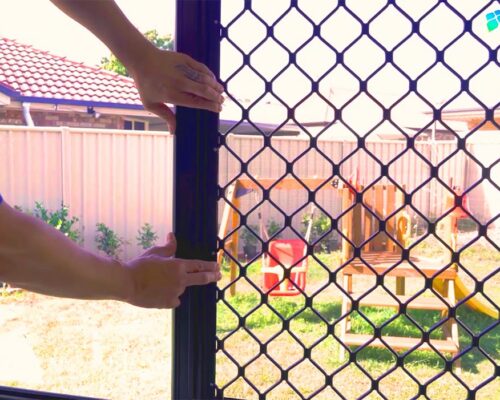
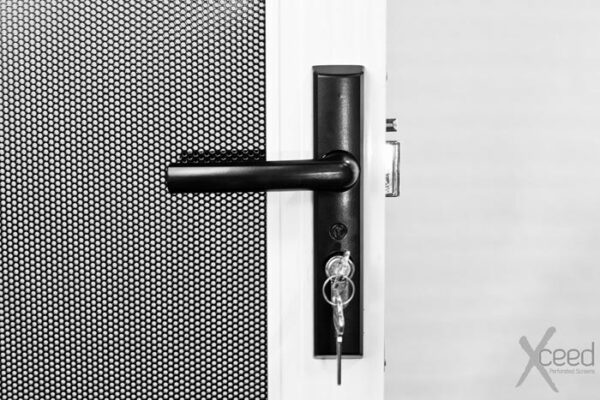
Diamond Grille doors can have another weakness if the internal snib is accessible through the grille and no lock guard has been installed. We fit lock guards to our Diamond Grille doors specifically to prevent somebody reaching through the grille and operating the inside lock. A surprising number of older Diamond Grille doors I inspect do not have this protection.
This does not mean every offender behaves the same way.
But my experience is consistent with Queensland Police advice that many break-ins are opportunistic and that quick or easy access through inadequately secured doors and windows increases vulnerability.
Remove the Easy Opportunity
This is one of the most important ways to think about home security.
The objective is not to make a home theoretically impossible to enter under every imaginable circumstance.
Instead, good security removes straightforward opportunities and makes forced entry more difficult, slower and noisier.
An ordinary flyscreen may stop mosquitoes, but it was never designed to stop a person deliberately trying to enter the home.
A weak single-point door lock presents a different level of resistance from a properly installed triple-lock security door.
A window that can easily be levered open presents a different opportunity from one that has been properly secured.
Queensland Police recommends approaching home security in layers and choosing measures that suit the property’s actual risks, budget and lifestyle.
That is very similar to the approach I take when walking around a home with a customer.
How Much of the Home Should You Secure?
There is a wide range of responses after someone experiences a break-in.
Some people want everything done — accessible windows, entry doors, sliding doors and bedrooms.
Others simply want the point where the original entry occurred secured.
Many customers fall somewhere between the two.
Budget plays a role. So does the person’s frame of mind after the incident and how they actually use their home.
When assessing a property, I normally look first at openings that are at ground level or otherwise easily accessible. I also look at which windows and doors the occupants regularly use and which ones they want to leave open.
Sometimes, particularly in a single-storey home, the sensible solution may be to secure virtually every accessible opening.
In other homes, security screens may be most important on frequently opened windows and doors, while less-used openings can be protected using suitable locks or physical stops.
Some people complete the work in one project.
Others do it in stages.
The important thing is not necessarily to install the most expensive product on every opening. It is to make sure every vulnerable opening has been considered.
Acting Quickly Without Acting Hastily
People who contact us shortly after a break-in normally want something done quickly.
That is understandable.
Availability therefore matters. If a customer has decided to improve their security, being able to assess the property and carry out the agreed work without unnecessary delay can be important.
But acting quickly does not mean acting without a plan.
Where are the genuine vulnerabilities?
Address those first.
Prioritise Vulnerable Openings — Especially Those You Want to Leave Open

This is particularly relevant on the Sunshine Coast.
Many of us want to open our homes to the breeze rather than keep every door and window shut.
During warmer months, bedroom windows may stay open at night. Sliding doors and living-area doors are regularly opened for ventilation.
That creates an important distinction between a locked home and a home that remains secure while it is being used normally.
A standard flyscreen is excellent for keeping insects outside. It does not provide the same physical resistance as a security screen.
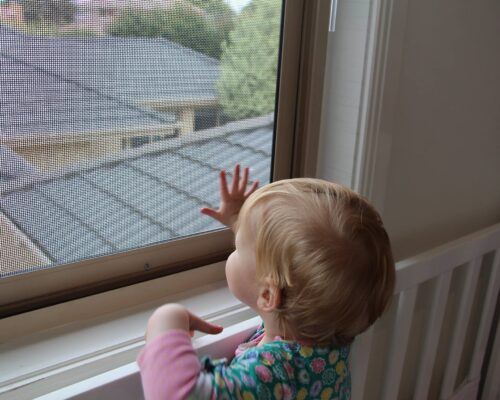
If a window needs to remain open overnight, particularly an easily accessible window, some form of physical security barrier becomes much more important.
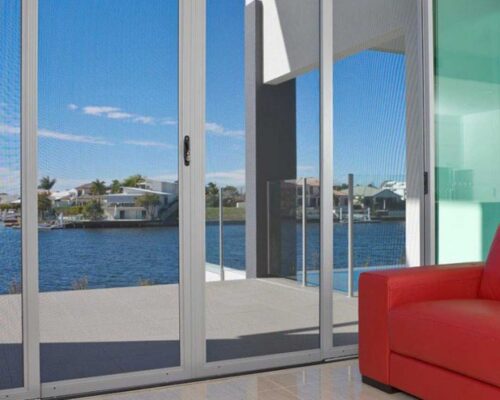
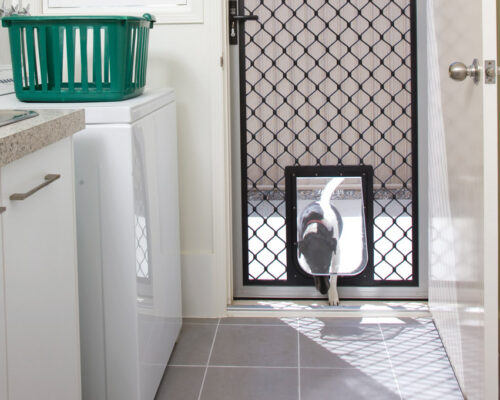
The same applies to doors. A properly secured screen door allows the main door to remain open for ventilation while still providing a physical barrier at the opening.
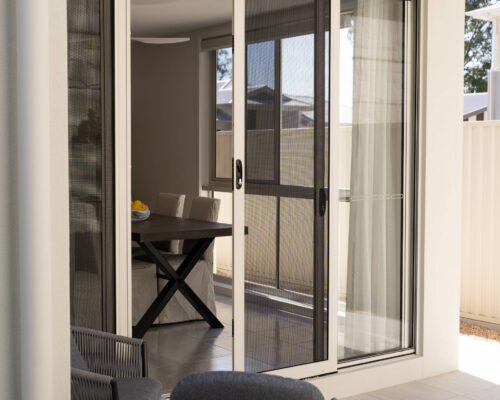
Home security should work with the way people live rather than requiring them to keep the house permanently closed. For more information on which security screens are best for the Sunshine Coast environment please read our guide – How to Choose Security Screens.
Why Home Security Works Best in Layers
Security screens are an important part of home security, but they are not the only part.
Queensland Police recommends a layered approach that can include appropriate locks, security screens, sensor lighting, CCTV cameras, alarms, visibility around the property and good security habits.
Each measure does a different job.
| Security measure | Main role | Physically secures an opening? |
|---|---|---|
| Sensor lighting | Improves visibility around the home | No |
| CCTV camera | Monitoring and recording | No |
| Door/window locks | Restricts or prevents opening | Yes |
| Barrier screen | Provides a physical barrier, but performance varies | To a degree |
| Compliant security screen | Designed and tested to resist forced entry | Yes |
Different layers complement each other.
The strongest approach is not to rely on one measure alone, but to make access more difficult at several points around the home.
Looking Secure and Being Secure Are Not the Same Thing
One of the interesting changes in security-screen design is that stronger products do not necessarily look more imposing.
Diamond Grille has traditionally provided a very obvious visual barrier. From the street or across a room, it looks substantial.
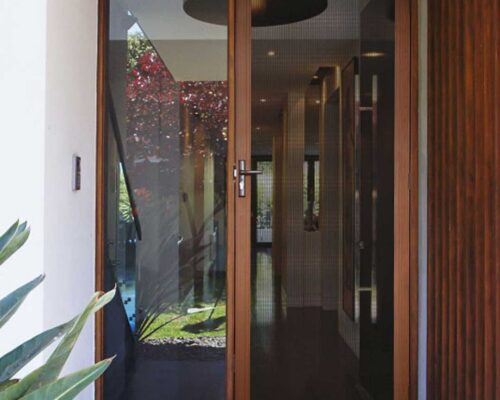
Modern stainless-steel mesh products such as SecureView can look surprisingly similar to an ordinary dark flyscreen until you look more closely.
The way a screen looks is not a reliable measure of its resistance to forced entry.
This does not mean every existing Diamond Grille door needs replacing.
If an older Diamond Grille door is otherwise serviceable, relatively simple improvements can sometimes make a worthwhile difference.
A lock guard is a good example. Depending on the door, upgrading the locking system may also be worth considering.
The objective should always be to identify the actual weakness before deciding whether to repair, upgrade or replace the product.
What Happens When a Proper Security Door Is Actually Attacked?
I have personally attended attempted break-ins involving SecureView doors.
The thing that stands out is that the door does not necessarily come through the attempted entry undamaged.
I have seen doors distorted during an attack. In some cases, the force applied causes the door to twist or jam into the doorway.
But entry has not been gained.
A security door that has been damaged while preventing an intruder from entering has not necessarily failed. If entry was prevented, the door may have done exactly what it was designed to do.
Most of the attacks I see on doors involve attempts to lever the lock side or the hinge side.
I have also seen attempts to kick security mesh from the frame. In the attempted break-ins I have personally attended involving SecureView, I have not seen the stainless-steel mesh successfully removed from the frame.
That is my experience rather than a claim that any product is impossible to defeat.
No responsible security company should promise that.
Why Installation Matters as Much as the Product
A security door is not simply a strong piece of mesh inside an aluminium frame.
A security door works as a complete system
The fitting gaps matter.
The locks matter.
The hinges matter.
The fixing screws matter.
The structure into which the door is being fixed matters.
On a hinged door, the correct number of hinges and suitable fixing screws become particularly important if someone attempts to lever the hinge side.
The lock side is equally important.
A properly installed triple lock restrains the door at multiple points rather than depending on a single latch.
The current Australian Standards reinforce this system-based approach.
A quality product fitted poorly can introduce weaknesses that should not be there.
What Does SL200 Tell a Homeowner?
Customers are becoming increasingly interested in documented security testing.
I think that is a positive development because it moves the discussion away from how strong a product looks and towards measurable performance.
The dynamic impact test used for the 200-joule level involves five consecutive 200-joule impacts and is designed to simulate heavy physical force against the screen.
It is important not to turn this into another marketing competition.
The value of documented testing is that it gives homeowners evidence of how the security-screen system has been designed and tested to perform.
And testing does not remove the need for correct installation.
The product, locking system, frame and installation all have to work together.

Repair, Upgrade or Replace?
After an attempted break-in, the best answer is not always to replace everything.
If an existing Diamond Grille door is still serviceable, a lock guard or suitable locking upgrade may address the weakness.
If a Diamond Grille door has been damaged during an attempted entry, customers will commonly choose to upgrade to a higher-level security product rather than replace it with another similar barrier door.
Where a SecureView door has resisted an attempted break-in, the door may still need to be replaced if the attack has distorted the frame, damaged the locking system or otherwise affected the way the door operates.
The important point is that damage does not necessarily mean the security door failed. If entry was prevented, the door may have done exactly what it was designed to do.
What was attacked, what held, and what now needs to be improved or replaced?
More Homeowners Are Trying to Get Ahead of the Problem
Not everyone who contacts Screens Plus has experienced a break-in.
In my experience homeowners are increasingly proactive about security.
We regularly meet people who have just bought a home and want to replace older Diamond Grille while upgrading the overall security at the same time.
Others have heard about incidents in their neighbourhood or through friends and family.
And during summer, some homeowners simply want to be able to sleep with a window or door open without worrying that an ordinary flyscreen is the only thing separating the room from outside.
These customers are applying many of the same lessons before an incident rather than afterwards.
That is often the best time to think about security.
What Does a Good Security Solution Actually Look Like?
Even after many years in this industry, I still pay close attention to the small details of every installation. Before I consider a job finished, I want to know that everything is fitted, locked and secured as it should be.
Security products have improved considerably over the years, and I am confident that when we supply a properly manufactured and installed security door or window screen, the customer is getting a product designed to provide genuine resistance against forced entry.
But the details still matter.
I want the finished door or window to feel tight and secure.
The gaps should be right.
The lock should engage properly.
The hinges, fixings and frame should all work together.
If someone pushes, pulls or tests the opening, it should feel like a properly secured part of the home rather than something that could easily be forced.
From what I have seen over the years, properly selected and properly installed physical security can make gaining entry substantially more difficult.
That is ultimately what the product is there to do.
Security Is Also About Being Comfortable in Your Home
There is another side to home security that is harder to measure.
Break-ins and attempted break-ins affect people.
They can change how comfortable somebody feels sleeping in their bedroom, leaving a window open or going out and leaving the house unattended.
That does not mean people should make security decisions purely from fear.
Good security should allow people to get back to using their homes normally.
On the Sunshine Coast, that may mean opening windows for airflow, leaving the main door open behind a security door or simply going to bed without continually wondering whether an accessible window is vulnerable.
What Should You Do After a Break-In or Nearby Incident?
A practical way to review your home security
1. Start with how access was gained or attempted
Identify the actual weakness rather than simply repairing visible damage.
2. Look for the same vulnerability elsewhere
If one window had a weak latch, are the others the same? If one door had an exposed snib, are there similar doors around the home?
3. Review accessible openings
Ground-level windows, doors, sliders and easily reached areas deserve particular attention.
4. Think about how you use the home
A permanently closed window may need a different solution from one you want open every night.
5. Use appropriate physical security where needed
Security doors, window screens, locks, lock guards and other restraints all have a place.
6. Consider the other layers
Sensor lighting, cameras, alarms, visibility and good security habits can complement physical security.
7. Stage the work if necessary
Prioritise the greatest vulnerabilities first and make sure the remaining openings are still appropriately secured.
A Sensible Response, Not a Fearful One
Repeat and near-repeat burglary are real enough phenomena to have been studied by criminologists and incorporated into crime-prevention strategies.
That does not mean a home which has been burgled will be burgled again.
It does not mean that because your neighbour experienced a break-in, your home will be next.
And it certainly does not mean people should live in fear.
What the research does tell us is that a previous or nearby incident can provide useful information about risk.
My own experience tells me something equally important: many break-ins exploit relatively straightforward weaknesses.
An open window behind a flyscreen.
A weak latch.
An accessible door lock.
An opening that looks secure without providing the level of physical resistance the homeowner assumed it did.
Those are things we can do something about.
The sensible response is to understand how entry can be gained, identify the vulnerable areas around the home and make proportionate improvements that suit the property, the way you live and the amount you want to spend.
You cannot remove every possible risk.
But you can make the easy opportunities much harder.
If you’re unsure which doors or windows around your home are most vulnerable, Screens Plus can walk through the property with you and help identify where security improvements will make the most practical difference.
Frequently Asked Questions About Home Security After a Break-In
Am I more likely to be burgled again after a break-in?
Research into repeat burglary shows that a home that has already been burgled can face a higher short-term risk of being targeted again. That does not mean another break-in is inevitable, but it is a sensible time to review how entry was gained and whether similar weaknesses exist elsewhere around the home.
Does a break-in nearby mean my home is at greater risk?
Near-repeat burglary research suggests that, for a period after an incident, nearby homes can also face an increased level of risk. The increase is temporary and does not mean surrounding homes will be targeted, but it can be a useful prompt to check accessible doors, windows, locks and other vulnerable openings.
What are the most common weak points around doors and windows?
In our experience, many break-ins involve simple weaknesses rather than sophisticated methods. These can include ordinary flyscreens, weak window latches, single-point door locks, accessible internal snibs and poorly fitted or inadequately secured openings. The best place to start is by identifying the easiest point of entry.
Do I need to upgrade every door and window after a break-in?
Not necessarily. A good security review should focus first on accessible openings, the way you use your home, and the areas where a real weakness exists. Some homes benefit from security screens on key doors and windows, while other openings may only need improved locks, physical stops or another practical upgrade.
Sources & Further Reading
- Australian Institute of Criminology — repeat victimisation and burglary research
- Queensland Police Service — home-security guidance and home-security audit
- College of Policing — repeat and near-repeat burglary prevention
- Journal of Quantitative Criminology — mathematical modelling of repeat and near-repeat burglary
- AS 5039 series — classification, installation and testing of security screen doors and window grilles
- Screens Plus — SL200 security screen testing and requirements